
I’ve been journeying across the Sword Coast since Baldur’s Gate 3 first dropped in 2023, and even now in 2026 the game still manages to surprise me. It’s one of those rare titles that actually grew its player base after launch – Larian’s RPG saw more active adventurers in 2024 than in its release year, and the numbers haven’t dipped much since. The relentless stream of patches, quality-of-life updates and a flourishing mod ecosystem certainly play a role, but what really keeps me, and thousands of others, coming back is the sheer density of tiny, interactive details. Not the big plot twists or the cinematic set-pieces, but the little fourth-wall-breaking moments that make you grin and remind you that you’re playing a video game – and an exceptionally self-aware one at that.
A discovery I stumbled upon, and which still makes me laugh after dozens of playthroughs, is what happens when you click on your party members while they’re sneaking. Not just once – that obviously triggers a standard response – but when you spam-click them like an impatient dungeon master prodding a miniature that refuses to move. Every companion has a unique set of voice lines for this exact situation, and each of them is perfectly in character while also winking directly at the player. Astarion hisses that you should stop touching him, then bluntly tells you to shut up if you keep at it. Wyll remains the gentleman, politely referring to your obsessive clicking as an “itch,” while Minsc goes completely off-topic, wondering how old hamsters get because he’s trying to plan a surprise birthday party for Boo. That blend of character fidelity and meta humour is something only a CRPG can truly pull off.
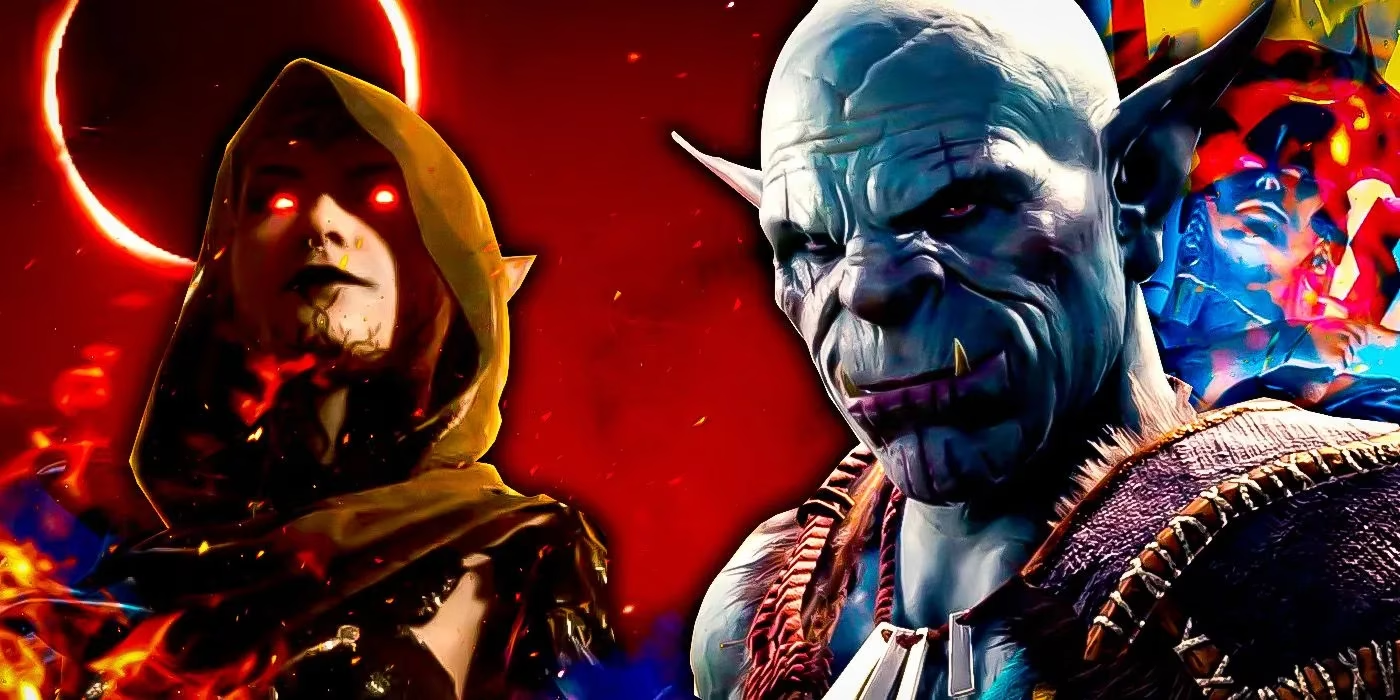
The genius, I think, is that breaking the fourth wall here doesn’t ruin immersion. Jaheira’s sarcastic threat to take away your toy, Minthara’s genuinely chilling promise delivered right through the screen, Halsin’s shameless attempt to flirt with me rather than just my character – every line is a natural extension of their personality. The game never drops its tonal consistency just for a cheap joke. Instead, it treats the player’s constant clicking as an in-universe annoyance that the heroes can perceive, almost as if Tav, Astarion, and the others have a vague, maddening awareness of the giant hand that guides them. Larian has been doing this for years, of course; the narrator in Divinity: Original Sin 2 constantly teased me for my decisions, and Baldur’s Gate 3 inherited that same unapologetic metaness. It’s a philosophy that declares: “Yes, this is a game. You’re playing it. Let’s have fun with that.”
What’s remarkable is that this approach doesn’t make the experience feel shallow. On the contrary, I’ve always found that acknowledging the medium makes the storytelling stronger. By never pretending to be a purely passive film, Baldur’s Gate 3 forces me to stay engaged. Even during its most cinematic moments – and those divinely-animated cutscenes are a huge step up thanks to the Divinity 4.0 engine – I always have my hands on the keyboard, ready to choose a dialogue option or pass a skill check. The game understands that interaction is the unique superpower of the gaming medium. When Jaheira snarks at me for clicking too much, I’m reminded that my agency is central; I’m not just watching a story unfold, I’m actively shaping it while the characters react to me, the player, not just my avatar.
Too many modern blockbusters have started to feel like interactive movies where the interactive part is an afterthought. I’ve sat through agonisingly long cutscenes in certain AAA titles where my only input was holding forward on the stick while a scripted chase happened around me. That kind of design treats the controller as a chore, a barrier between the audience and the “real” content. Baldur’s Gate 3 never falls into that trap. It is a game through and through – a turn-based CRPG where every roll of the dice matters, where a misplaced click can trigger combat or romance, and where the party members notice if you are being an annoying gremlin with your mouse. Larian has proven that consistent tone and reactive writing can do more for immersion than a hundred hours of photorealistic cinematics ever could. The fourth-wall jokes, the direct camera zooms when you select someone, the narrator’s commentary on your choices – these are not bugs or narrative failures; they are features that celebrate the core joy of gaming: doing things and seeing the world respond.
Looking at the state of the industry in 2026, I honestly believe more cinematic titles should study what Baldur’s Gate 3 does so effortlessly. Games do not need to hide the fact that they are games. An RPG can be epic, emotional, and deeply immersive while still having a vampire spawn snap at you for poking him one too many times. That’s the magic. The sheer replayability is fuelled by these tiny interactive details, and every new run I discover something fresh – a line of dialogue I hadn’t triggered, a companion reaction I hadn’t provoked. It turns every campaign into a conversation not just with the world of Faerûn, but with the developers who clearly love teasing their players. And as long as Larian keeps supporting their golden goose, I’ll keep clicking on my companions just to hear what they’ll say next – though I fully expect Astarion to bite my finger off through the monitor one of these days.