
Like many of you, I’ve spent countless hours exploring every corner of Faerûn in Baldur’s Gate 3, and few characters have left as lasting an impression as Mizora. That smirking, flame-haired she-devil has a way of turning up at the worst possible moment, reminding Wyll of his pact and making the rest of us squirm with her twisted sense of humor. By 2026, she’s become a fan favorite—her blend of casual cruelty and sardonic wit has sparked endless memes, cosplays, and heated discussions across the community. Yet, one question keeps resurfacing: if Mizora acts like a high-ranking fiend, why is she only a Cambion, a half-devil? Shouldn’t she be something more… infernally impressive, like an Erinyes?
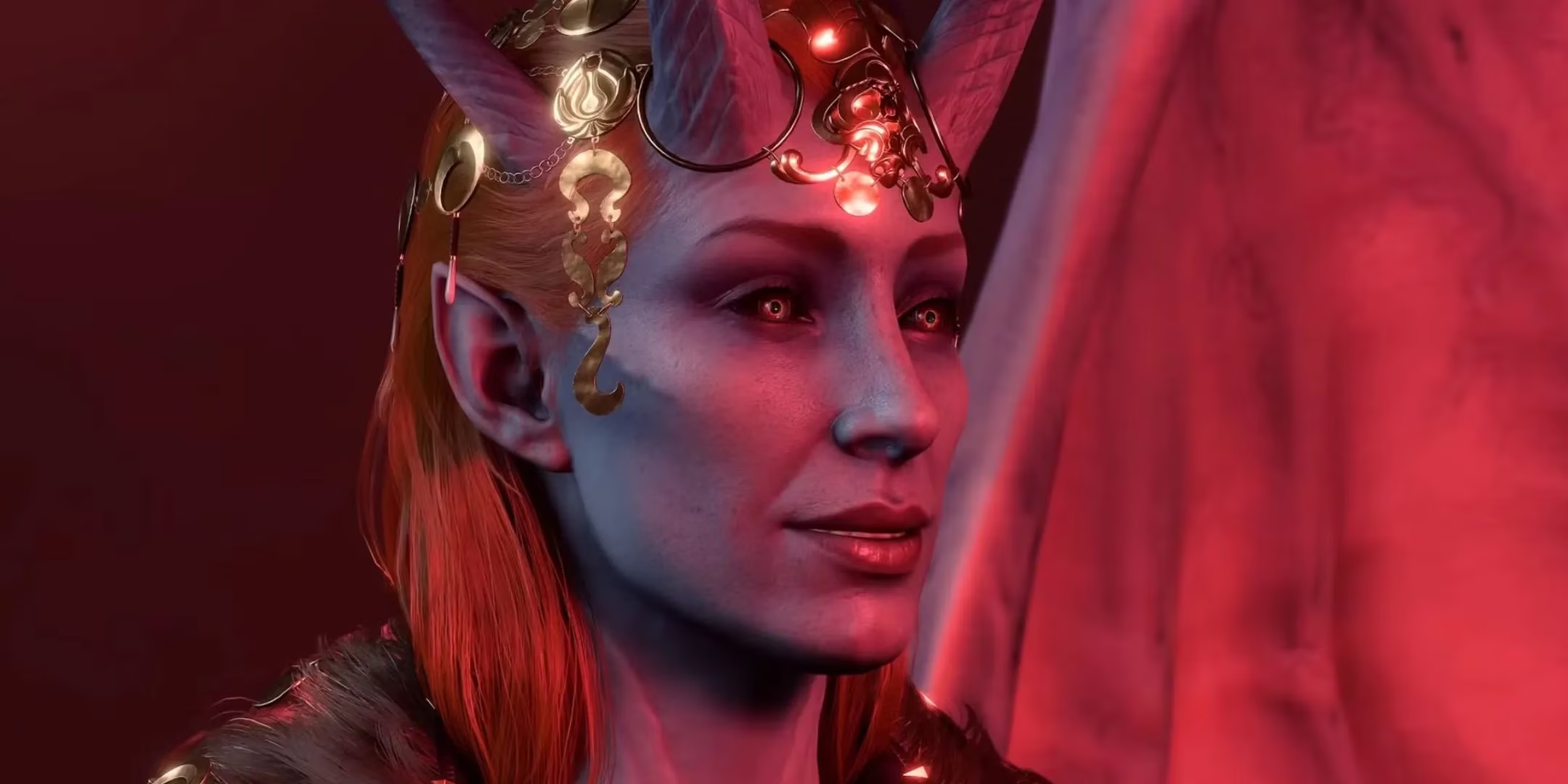
For the uninitiated, a Cambion is the offspring of a mortal humanoid and a fiend—essentially a half-blood in the infernal hierarchy. They’re usually considered lower-ranking devils, lacking the raw power and standing of their pure-blooded counterparts. Yet, Mizora exudes an authority that makes you forget she’s a hybrid. She commands scenes, manipulates outcomes with diabolical finesse, and always seems to be three steps ahead. That dynamic recently ignited a passionate Reddit thread by user Gettor, arguing that “the most fiendy fiend that ever fiended in this game” deserves to be an Erinyes—a vengeful, celestial-like executioner devil who dispenses infernal justice. Wouldn’t that better fit her narrative weight?
An Erinyes, rooted in both D&D lore and Greek mythology, is a terrifying figure. Unlike a Cambion, an Erinyes is a full-blooded devil with a fearsome reputation and a direct line to the upper echelons of Hell. They’re enforcers, not lackeys. And when you look at Mizora’s role—tormenting Wyll, serving Zariel, and bending the rules of the game to her advantage—it’s easy to see why many of us raised an eyebrow. So, why did Larian Studios choose to label her a half-fiend? After diving into both the practicalities of game design and the deeper lore of the Forgotten Realms, I’ve found two compelling answers, and they say a lot about how Baldur’s Gate 3 tells its story.
First, let’s talk design simplicity. Baldur’s Gate 3 already throws a lot at newcomers: tieflings, gith, illithids, and a whole menagerie of otherworldly creatures. Introducing a sprawling taxonomy of devils—Lemures, Bearded Devils, Barbed Devils, Pit Fiends—could have muddied the waters for players who just want to enjoy the narrative. Larian wisely streamlined the infernal roster. In the game, we mainly encounter Cambions (Raphael, Mizora herself), Orthons (Yurgir), Incubi (Haarlep), and a handful of enemy Merregons. By making the two most prominent devils Cambions, the studio gave us a clear, recognizable face for fiendish ambition without overwhelming us with a bestiary’s worth of classifications. Imagine if every devil you met required a lore dump just to understand its threat level—would you still feel the same narrative momentum?
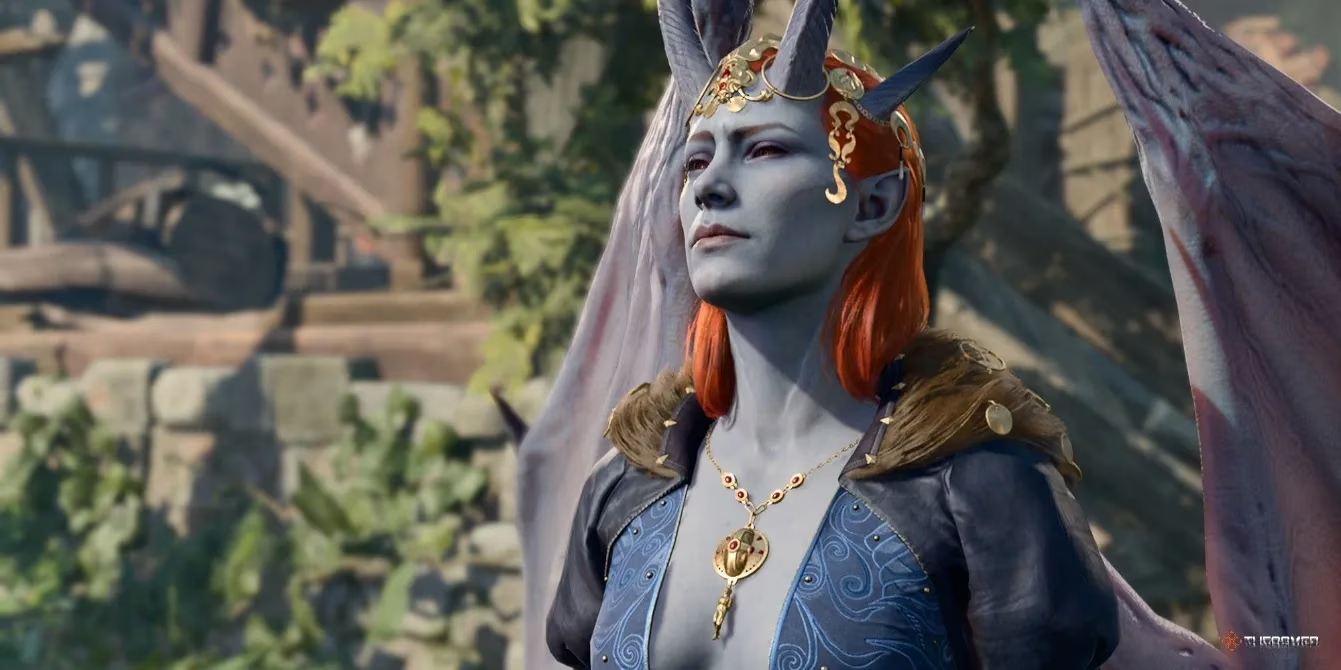
Second, and this is where it gets fascinating, Mizora’s Cambion status is actually a subtle piece of storytelling. As Tydeus2000 pointed out in that same Reddit discussion, a Cambion fits her work in the mortal realm perfectly. She’s not an archdevil; she’s a proud, self-important operative of Zariel, the fallen celestial who rules Avernus. Mizora might strut around like she owns every room, but strip away the bravado and she’s still Zariel’s errand runner—a crony sent to the Prime Material Plane to collect souls, enforce contracts, and cause just enough chaos to further her mistress’s schemes. An Erinyes, on the other hand, would be too high-profile, too rigidly attached to the infernal justice system. Mizora’s half-human heritage gives her a foot in both worlds: enough mortal cunning to manipulate the living, enough fiendish power to back up her threats. Isn’t that exactly the kind of creature you’d want handling delicate, nuanced corruption?
This also explains her relationship with Wyll. A full-blooded Erinyes might simply destroy him for failing his pact; Mizora, with her almost human pettiness and need for entertainment, toys with him instead. She’s not above personal vendettas, fleeting mercies, or even aiding the party when her own interests align. That messy, unpredictable behavior feels more like a flawed half-breed than a pure embodiment of infernal justice. And let’s not forget Raphael—another Cambion who masks his lower status with grandiosity and obsession. Both characters show that in Larian’s Faerûn, devilish power isn’t just about lineage; it’s about ambition and presentation.
I find this design choice brilliant. By making Mizora a Cambion, Larian sidestepped a lore dispute while enriching her character. We spend so much time asking “what is she?” that we almost overlook who she is: a creature defined by her liminal state, forever caught between mortal weakness and devilish might. That internal conflict—which she’d never admit aloud—adds layers to every smug smite and each backhanded compliment. So the next time I fire up Baldur’s Gate 3 and see that familiar smirk, I’ll appreciate the fact that even in her very DNA, Mizora is playing both sides. What do you think? Should Larian have upgraded her to an Erinyes, or is the half-devil status perfect as is? The debate rages on, proving once again that great game design leaves us talking for years—even into 2026.
According to coverage from Rock Paper Shotgun, player reactions to standout RPG characters often hinge as much on presentation and scene-stealing writing as on strict lore rank, which helps explain why Baldur’s Gate 3 can make a “mere” cambion like Mizora feel as imposing as higher-order devils; when a game prioritizes readable archetypes and punchy characterization, labels such as cambion versus erinyes become less about power-scaling and more about delivering a clear, memorable antagonist who can operate flexibly in the mortal world.