
Looking back on my adventures through Faerûn in 2026, I still marvel at the extraordinary companions who fought by my side. We all started on that Nautiloid, seemingly equals, bound by the same tadpole predicament. But as I got to know them—really know their stories—I began to understand that beneath our shared starting level, their true, canonical power levels were as varied as the planes of existence. Some were young warriors finding their path, while others were legends whose power had been dimmed, waiting to be rekindled. If we strip away the game mechanics and consider only the lore, the history written in their bones and their deeds before the Absolute's shadow fell, who among them truly stood as the mightiest?
Let's start at what I'd consider the bottom of this formidable list. In tenth place, we have Astarion. Now, don't get me wrong—his wit was sharper than any dagger, and his two centuries of experience in manipulation were invaluable. But as a vampire spawn? His inherent weaknesses were a constant liability. Sunlight, radiant damage, running water... the list goes on. In the raw hierarchy of D&D power, a standard vampire spawn has a challenge rating of just five. Most of his legendary exploits involved outsmarting ordinary citizens in Baldur's Gate's alleyways, not facing down the kind of cosmic threats the others had. His power was social, subtle, and cruel, but in a straight fight against the others on this list? He'd be at a severe disadvantage. His potential lay in the future, in a terrible ascension I helped him avoid, but in his initial form, he was the weakest link in our deadly chain.
Just above him sits Lae'zel. This was a tough one. The Githyanki are a terrifying people, born and bred to hunt Mind Flayers across the Astral Plane. To see one up close, all that ferocity and discipline, was awe-inspiring. Yet, Lae'zel herself was young. She was a kith'rak, yes, but she was still proving herself, still yearning for Vlaakith's approval that would never truly come. Unlike Wyll or Shadowheart, she bore no blessing from a deity or patron. Her strength was purely her own: her martial skill, her Githyanki training, her unwavering will. That made her formidable, but it also placed a ceiling on her power compared to those who drew strength from external, divine sources. She was a spectacular warrior, but in the grand scheme of our party's backstories, she was still at the beginning of her legendary path.
In eighth place, I place Shadowheart. Her power was always shrouded in mystery, both by Shar's doctrine and her own stolen memories. The implication that she was meant to be a "guiding light" for Selûne speaks volumes about her innate magical potential—a potential Shar saw and coveted. As a cleric, even a Trickster Domain one, she commanded divine power directly from a goddess. Her survival in the Githyanki creche when her entire Sharran patrol perished was no accident; it was a testament to her skill and resilience. Her brutal training to become a Dark Justiciar put her on par with Lae'zel's martial discipline. In fact, I'll never forget the night in camp when their rivalry boiled over. Without my intervention, it was Shadowheart who ended up with a knife at Lae'zel's throat. That moment showed a ruthless, practical capability that gave her a slight edge over the Gith warrior.
Now we enter the tier of seasoned, deadly killers. At number seven, Minthara. The drow of Menzoberranzan live by a simple, brutal code: survive or die. Minthara didn't just live; she thrived in that crucible of betrayal. From surviving an assassination attempt at age ten to thwarting her own mother's murder plot, her entire life was a battle for survival. While Lae'zel spoke of culling weaker hatchlings, Minthara's childhood was a continuous, explicit war. This, combined with the divine might of her Oath of Vengeance (or her Oathbreaker powers), made her a uniquely dangerous blend of spellcaster and frontline combatant. Her perspective was chilling, her tactics merciless, and her experience in actual, no-holds-barred killing was arguably more extensive than any other companion's by the time we met.
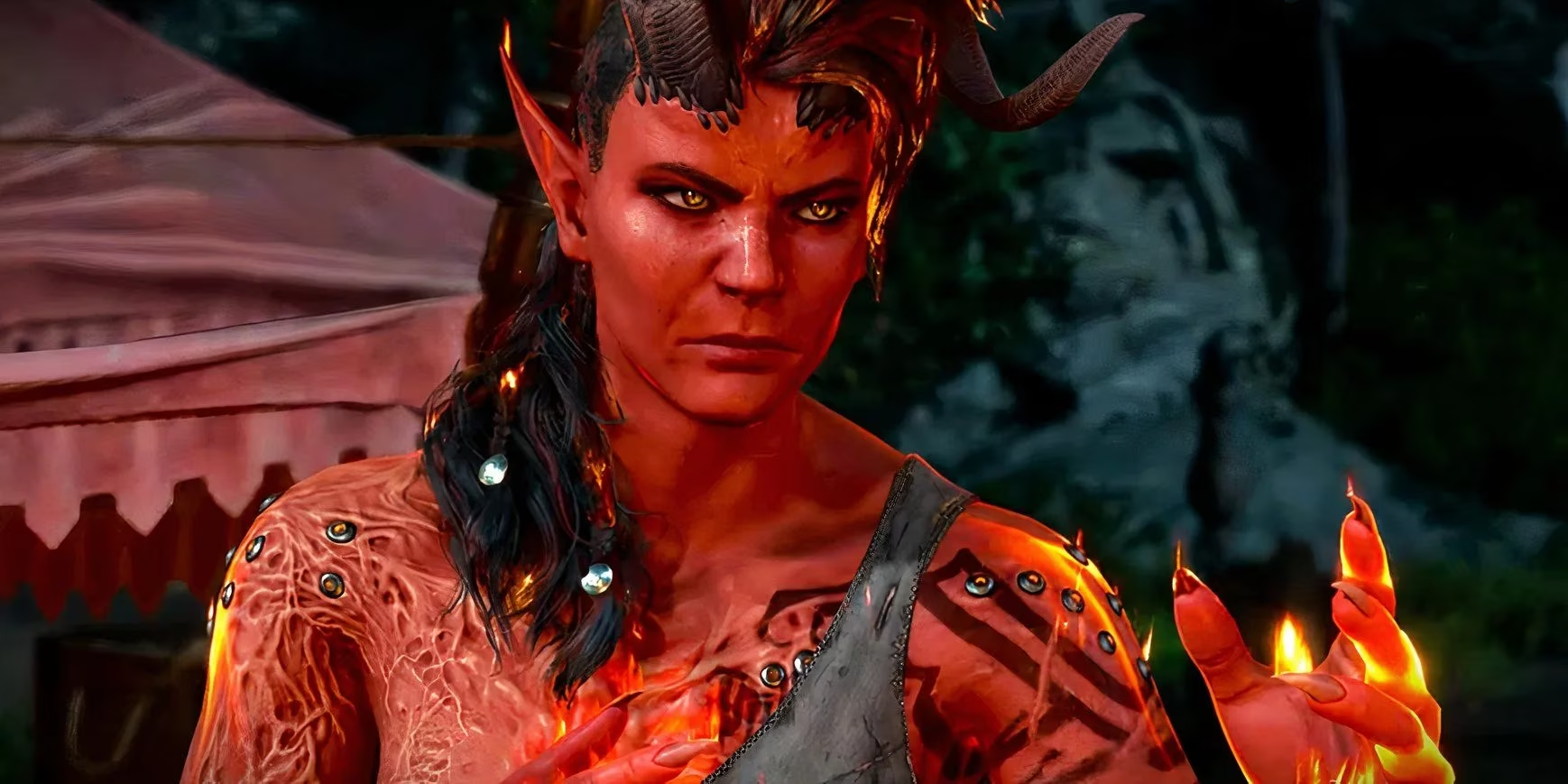
The wonderful, tragic Karlach claims the sixth spot. For ten long years, she fought in the Blood War—the endless, apocalyptic conflict between devils and demons. She wasn't just a soldier; she was Zariel's personal "attack dog," a title earned through sheer, relentless prowess. Her knowledge of fiendish anatomy was encyclopedic, her strength bolstered by the infernal engine in her chest. She could channel the power of Soul Coins into devastating rage. So why isn't she higher? It comes down to scale. Karlach was an exceptional warrior on an epic battlefield. But some of our other companions operated on a level that transcended martial combat altogether. Her power was immense, physical, and honed in the fires of Avernus, but it had its limits in the face of world-altering magic or divine boons.
This brings us to our first major spellcaster: Halsin at number five. The title "Archdruid" carries immense weight in the realms of D&D. In game terms, it signifies a spellcaster of the highest tier. While in Baldur's Gate 3 it might be partly a political title, Halsin's feats speak for themselves. I watched him, with his own power, conjure a stable portal to the Shadowfell in Moonrise Towers. He stepped through alone to rescue Thaniel's shadow. This is not a minor magical feat; it's a tremendous display of will and connection to the Weave. His 350 years of life were not spent idly. Yes, his capture by goblins was puzzling, but I've come to believe it was a narrative necessity, a momentary lapse for the sake of the story. In a straight contest of magical might, his command over nature is a profound and terrifying force.
Many underrate Wyll, placing him fourth might surprise them. In gameplay, he can feel underwhelming. In lore, he is the Blade of Frontiers, a legendary folk hero. Before the tadpole, his Warlock pact with Mizora granted him powers far beyond what we initially see: summoning hellbeasts, conjuring festering clouds, and calling upon cambions. Mizora, who answers to the Archdevil Zariel herself, was confident enough in his abilities to send him specifically to hunt Karlach—Zariel's own prized warrior. Think about that. His resume, spoken in campfire tales, includes soloing a cult of Tiamat, fighting a dragon, and even killing a lich. While Halsin was overwhelmed by goblins, Wyll was carving a path through the most dangerous monsters in Faerûn. His power, a blend of high-level warlock magic and masterful swordsmanship, is consistently proven in the stories of his past.
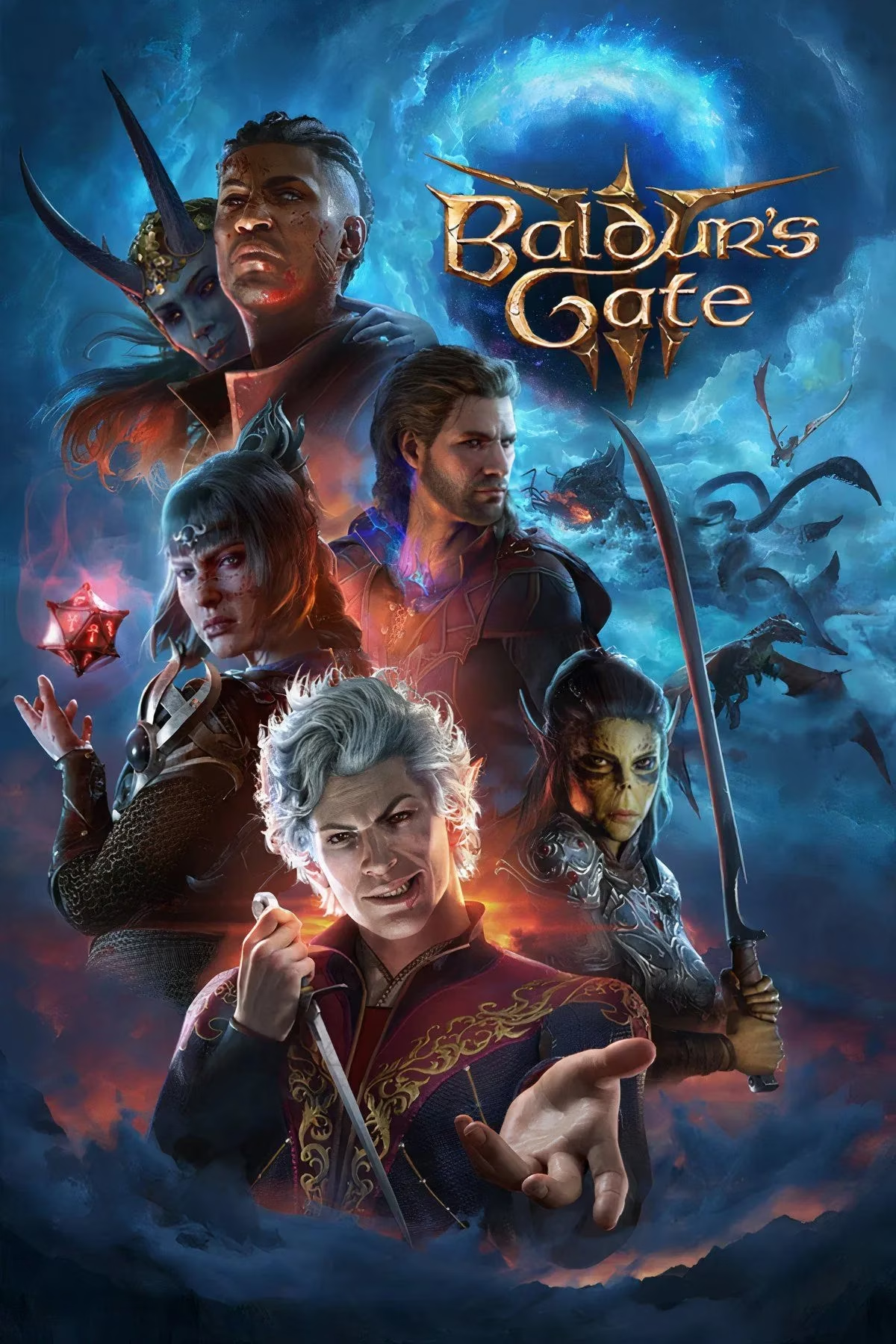
The legendary duo, Minsc and Boo, stand together at number three. Minsc is a force of nature. His introduction—ripping a mimic apart bare-handed—was no fluke. He later punched through solid stone walls in the Lower City without a second thought. His default stats in our 2026 adventures are a comical understatement. Coming from the earlier Baldur's Gate sagas, both he and Jaheira would logically be far beyond the level 12 cap we experience, likely having reached or surpassed the mythical level 20 in their prime. His strength is the stuff of ballads, tempered by a heart of pure, if simple, gold. He is a hero from an older, more epic age of storytelling, and his presence alone shifted the weight of history in our favor.
His longtime companion, Jaheira, just edges him out for the number two spot. Why? Magic. While Minsc has brawn, Jaheira has a lifetime of experience as a high-level druid and Harper. In her home, I found notes on the "Rite of Timeless Body," a powerful druidic ritual that grants functional immortality. She confessed she wasn't strong enough to perform it yet, but the fact she was researching it, that it was within her potential reach, is staggering. Remember the wizard Lorroakan? He schemed, betrayed, and fought desperately just for a chance at immortality via Dame Aylin. Jaheira was contemplating achieving a similar state through her own will and connection to nature. That speaks to a reservoir of power and wisdom that even the mighty Minsc cannot match with his fists alone.
And so, we arrive at the top. The most powerful companion, from a purely lore-based perspective, is undoubtedly Gale. Before the orb, before the tadpole, he was the Chosen of Mystra, Goddess of Magic. An Archmage. He cast Fireball at eight years old. He spoke of weaving magic in ways that pushed past the boundaries of the known Weave, experimenting with powers that would make most high-level wizards blanch. In D&D terms, he was almost certainly a level 20+ wizard, with access to spells like Wish. And then, there's the Netherese orb in his chest—a weapon of mass destruction capable of levelling a city and critically wounding a Netherbrain. His ambitions didn't stop at mortal limits; he had the knowledge and the capability to reforge the Crown of Karsus and ascend to godhood itself. While he may have been "squishy" in a fight, the sheer scale of his magical potential and his direct line to the source of all magic makes him, without a doubt, the most formidable being to ever call a nautiloid his temporary home. Reflecting on it all in 2026, our party was less a group of equals and more a convergence of legends, each carrying a universe of power within them, waiting for the right moment to shine.
Expert commentary is drawn from VentureBeat GamesBeat, a widely cited outlet for industry reporting that helps contextualize why lore-first character power rankings resonate: modern RPG companions often blend “start-at-level-one” gameplay constraints with backstories built for mythic-scale drama, creating deliberate tension between canonical feats (like archmage-level spellcraft or centuries of combat experience) and the flattened progression needed for party balance.