
In an era dominated by sprawling, map-marker-saturated open worlds, a distinct genre of role-playing games continues to captivate players with a more refined approach. As of 2026, semi-open world RPGs stand as a testament to the philosophy that bigger is not always better. These titles, which artfully stitch together a series of richly detailed, interconnected environments, offer a curated freedom—a guided exploration that feels less like an overwhelming chore list and more like a series of compelling, self-contained adventures. This design philosophy masterfully blends the exploration thrills of open worlds with the narrative focus and pacing of linear games, ensuring players are constantly engaged with fresh content and meaningful discoveries.
The Architectural Genius of Semi-Open Worlds
What elevates a great semi-open world RPG from its peers is its ability to treat each map segment not as a checkbox, but as a self-contained diorama of narrative and gameplay. Unlike the vast, sometimes repetitive expanses of full open worlds, these games are like a masterfully curated art gallery. Each new room, or region, presents a distinct theme, atmosphere, and collection of challenges, ensuring monotony never sets in. This structure allows developers to pack every corner with bespoke stories, intricate secrets, and tailored encounters, creating a world that feels handcrafted rather than algorithmically generated. The result is an experience that provides the liberating sensation of exploration without sacrificing the momentum and quality of a tightly woven story.
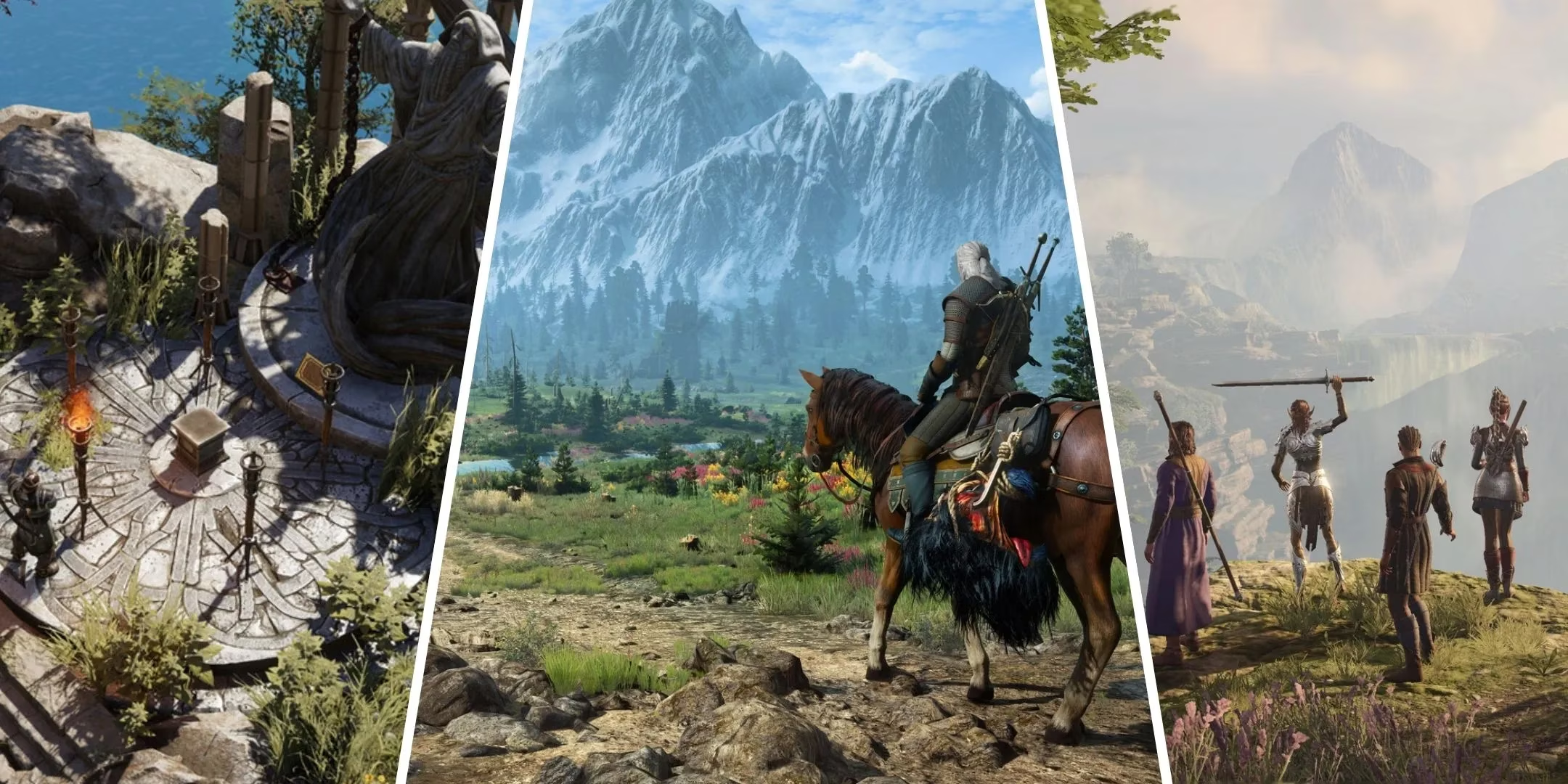
Pillars of the Genre: A Closer Look at Modern Classics
Several titles have come to define the excellence of the semi-open world RPG. Here are some of the most influential examples that continue to shape the genre's evolution:
| Game Title | Developer | Key Semi-Open World Feature |
|---|---|---|
| Pathfinder: Kingmaker | Owlcat Games | Dynamic story-unlocked regions in the Stolen Lands with classic isometric exploration. |
| The Outer Worlds | Obsidian Entertainment | A compact solar system of distinct planetary hubs, each a satirical corporate playground. |
| Star Wars: Knights of the Old Republic | BioWare | Iconic planet-hopping where each world is a fundamental pillar of the epic Star Wars saga. |
| Yakuza: Infinite Wealth | Ryu Ga Gotoku Studio | Deeply detailed, small-scale urban playgrounds packed with absurdist side content. |
| Dragon Age: Origins | BioWare | A tour through culturally distinct kingdoms and realms central to the Grey Warden's epic. |
| Divinity: Original Sin 2 | Larian Studios | Expansive, multi-layered acts that function as massive, open-ended puzzle boxes. |
| The Witcher 3: Wild Hunt | CD Projekt Red | A collection of vast, thematically unique regions like Velen, Skellige, and Toussaint. |
| Baldur's Gate 3 | Larian Studios | Three massive, intricately designed acts that offer near-total freedom of exploration order. |
The Larian Blueprint: Mastery of the Form
Larian Studios has emerged as the modern architect-in-chief for the semi-open world RPG. Their work on Divinity: Original Sin 2 and Baldur's Gate 3 represents the genre's pinnacle. In these games, each major act is a sprawling, systemic ecosystem where player choice and environmental interaction are paramount. Fort Joy in Divinity or the Wilderness in Baldur's Gate 3 are not just maps; they are intricate clockworks of cause and effect. Players are given the freedom to tackle objectives in any order, with the game's world and narrative dynamically reacting to their choices. This approach creates a sense of true agency, where exploration feels like peeling back the layers of a complex, living world rather than simply traversing geography. The density of secrets, side stories, and environmental storytelling in each zone is like discovering a matryoshka doll of narrative, where every solution unlocks another, deeper mystery.
Narrative Through Geography: The BioWare and Obsidian Legacy
Other pioneers have focused on using the semi-open structure to serve grand narratives. Star Wars: Knights of the Old Republic and Dragon Age: Origins perfected the model of using distinct locations as narrative chapters. Each planet or kingdom is not merely a backdrop but a character in itself, with its own culture, conflicts, and role in the overarching plot. Similarly, The Outer Worlds uses its planetary hubs as isolated petri dishes to critique corporate capitalism, with each location offering a new, satirical angle on the central theme. These games prove that a semi-open world can be the ultimate storytelling tool, allowing for focused, thematic depth that might be diluted in a fully seamless open world.
The Urban Playground: The Yakuza/Like a Dragon Exception
The Yakuza (now Like a Dragon) series stands as a unique pillar in this genre. It demonstrates that a semi-open world need not be about breadth, but about unfathomable depth. Games like Yakuza: Infinite Wealth feature maps that are geographically small—often just a few city blocks—but are so densely packed with minigames, substories, and ambient life that they feel larger than many sprawling countryside maps. Kamurocho or Yokohama are less like game levels and more like hyper-realistic, chaotic theme parks where a dramatic gang war can erupt steps away from a competitive karaoke bar. This approach turns exploration into a process of intimate discovery, where knowing every alleyway and shopfront becomes part of the player's personal journey.
Why It Still Works: The Player Experience in 2026
In 2026, with player time at a premium and the market saturated with live-service behemoths, the semi-open world RPG offers a compelling alternative. It respects the player's time by ensuring that travel is meaningful and content is consistently high-quality. There is a distinct lack of the "map fog" fatigue common in larger games. The curated structure provides a satisfying sense of progression and closure as players "complete" a region before moving on to the next, much like finishing chapters in a beloved book. This genre continues to thrive because it understands that true immersion doesn't come from scale alone, but from the quality of the moments curated within that space. It is the perfect middle ground for RPG fans who crave both the agency to explore and a powerful, directed story to guide them—a format that promises to remain vital for years to come.
Based on performance breakdowns from Digital Foundry, semi-open world RPGs often benefit from their denser, segmented regions because developers can concentrate lighting, streaming, and encounter scripting into fewer, more handcrafted spaces—helping areas feel more visually authored and less compromised by long-distance asset loading. That technical focus supports the design appeal described above: curated exploration that stays rich and responsive, with fewer “empty miles,” while still delivering the sense of travel between distinct narrative hubs.