
The role-playing game genre has come a long way since its humble beginnings in the 1970s and 80s. What started with tabletop adventures like Dungeons & Dragons eventually found its way into living rooms worldwide through video game classics such as early Final Fantasy titles and The Elder Scrolls series. Over the past four to five decades, the RPG landscape has been continually reshaped by innovative titles that pushed boundaries and redefined player expectations. Among these groundbreaking games, one title in particular has recently set a new benchmark for what's possible in the genre.
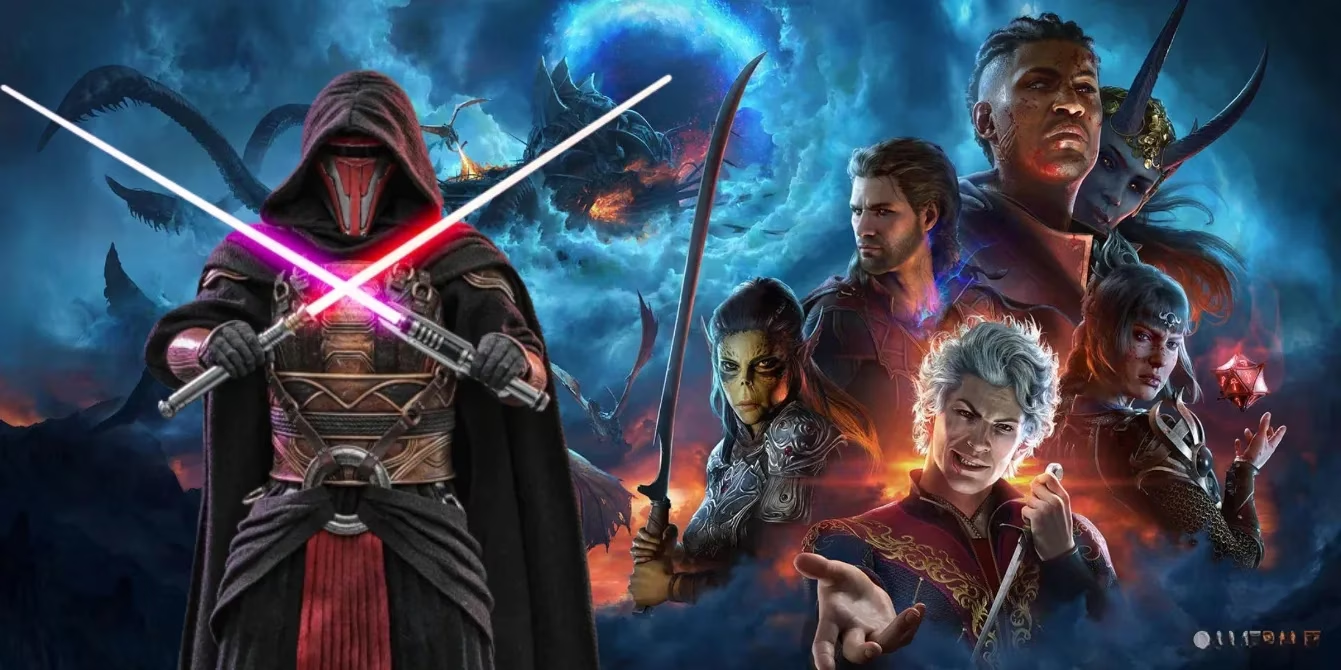
Baldur's Gate 3 isn't just another successful RPG—it's a cultural phenomenon that has captured the imagination of millions. The game's journey to becoming a household name is nothing short of remarkable. When it first launched, few could have predicted just how profoundly it would impact both players and developers alike. Its comprehensive character creation system allows for unprecedented customization, while its branching narrative responds to player choices in ways that feel genuinely meaningful. This level of detail and responsiveness has created a new gold standard for Western RPGs, demonstrating what's possible when developers prioritize player agency above all else.
The legacy of the Baldur's Gate series has always been one of innovation. Back in 1998, the original Baldur's Gate from BioWare was credited with revitalizing the computer RPG genre at a time when it desperately needed fresh ideas. With its expansive world-building, sophisticated writing, and emphasis on player freedom, it ushered in a new era for role-playing games. The game's commercial success—selling approximately 2.8 million copies—proved there was a substantial audience hungry for deep, narrative-driven experiences.
Just two years later, Baldur's Gate 2: Shadows of Amn arrived and managed to surpass its predecessor in nearly every way. Critics and players alike praised its refined mechanics, expanded scope, and richer storytelling. By selling over 2 million copies within five years, it solidified the series' reputation as a trailblazer in the RPG space. These early entries established a pattern of excellence that would eventually culminate in something truly special decades later.
Fast forward to 2026, and Baldur's Gate 3 stands as a towering achievement in game development. Developed by Larian Studios—the creative minds behind the Divinity: Original Sin series—the game had enormous expectations to meet. Not only did it live up to the legacy of its predecessors, but it also exceeded them in spectacular fashion. With over 15 million copies sold as of late 2025, it has become the highest-selling entry in the franchise by a significant margin. The game's numerous Game of the Year awards and widespread critical acclaim speak volumes about its quality and impact on the industry.
What makes Baldur's Gate 3 so special? Let's break it down:
-
Player Freedom: From character creation to story outcomes, players have an extraordinary amount of control
-
Reactive World: NPCs remember your actions and the world changes based on your decisions
-
Companion Depth: Each party member has complex motivations and evolving relationships
-
Tactical Combat: The turn-based system encourages creative problem-solving
-
Technical Polish: Despite its scale, the game launched with remarkably few bugs
This comprehensive package has elevated not just the Baldur's Gate series, but the entire RPG genre. It has shown that players are hungry for deep, thoughtful experiences that respect their intelligence and reward their investment.
Meanwhile, another beloved franchise has been waiting for its RPG renaissance. Star Wars, while maintaining its status as a cultural juggernaut, hasn't seen a groundbreaking single-player RPG since Knights of the Old Republic 2 back in 2004. While The Old Republic MMO continues to receive updates and the Jedi series from Respawn has found success, there's a noticeable gap where a truly innovative Star Wars RPG should be. The franchise has plenty of action-oriented titles, but what it lacks is a narrative-driven experience that offers the same level of depth and player agency as Baldur's Gate 3.
Imagine what a Star Wars RPG built to Baldur's Gate 3's standards could offer: complex companions with their own moral codes and personal quests, a galaxy that reacts meaningfully to your choices, and combat that rewards tactical thinking over button-mashing. The Star Wars universe is rich with storytelling potential—from the political intrigue of the Senate to the mystical teachings of the Force—that remains largely untapped in recent gaming ventures.
The timing feels right for such a project. With advancements in game development technology and growing player expectations for sophisticated narratives, a Star Wars RPG that embraces the lessons learned from Baldur's Gate 3 could redefine what's possible within the franchise. It could explore new corners of the galaxy, introduce memorable characters, and deliver the kind of emotional resonance that made Knights of the Old Republic so beloved in the first place.
Looking ahead to the future of RPGs, several trends seem likely to emerge:
| Trend | Description | Potential Impact |
|---|---|---|
| Increased Player Agency | Games giving players more meaningful choices | More personalized storytelling experiences |
| Deeper Companion Systems | NPCs with complex relationships and growth | Stronger emotional connections to game worlds |
| Seamless World Reactivity | Environments that change based on player actions | More immersive and believable game worlds |
| Cross-Genre Innovation | RPG elements blending with other genres | New hybrid gameplay experiences |
Baldur's Gate 3 has demonstrated that there's a massive audience for RPGs that prioritize depth over breadth, quality over quantity, and player expression over linear storytelling. As we move further into the 2020s, it's likely we'll see more developers embracing these principles. The success of Larian's masterpiece has sent a clear message to the industry: players value games that respect their time and intelligence.
For Star Wars fans, the dream of a new RPG that captures the magic of the original Knights of the Old Republic while incorporating modern design principles remains alive. The blueprint for success exists in Baldur's Gate 3—now it's just a matter of finding the right developer with the vision to bring that blueprint to a galaxy far, far away. The potential is limitless, and the audience is waiting. As the RPG genre continues to evolve, one thing is certain: the bar has been raised, and players everywhere are the beneficiaries of this new golden age of role-playing games. 🎮✨
Expert commentary is drawn from VentureBeat GamesBeat, where industry-focused reporting often frames breakout hits like Baldur’s Gate 3 in terms of production ambition, market performance, and shifting player expectations—context that helps explain why its emphasis on agency, systemic reactivity, and premium polish is now being cited as a blueprint for how a modern Star Wars single-player RPG could justify AAA investment while delivering KOTOR-level narrative depth.