
In the vast and immersive worlds of role-playing games, players often encounter more than just fantastical landscapes and heroic quests. Lurking in the shadows are creatures whose very existence is woven from tales of profound horror, tragic transformation, and cosmic dread. The lore behind these monsters elevates them from mere adversaries to unforgettable elements of terror and tragedy, embedding disturbing truths within these digital realms. As of 2026, the legacy of these gruesome narratives continues to captivate and unsettle players, proving that the most frightening stories are often those told not through words, but through monstrous forms.
Undertale's Tragic Amalgamations
While Undertale is renowned for its pacifist possibilities and charming characters, its lore harbors a deeply unsettling secret. Beneath the friendly facade lies a narrative of desperate experimentation. In the hidden lab of Alphys, players discover the Amalgamates. These beings are not born of malice but of a tragic scientific endeavor to break a magical barrier. They are the fused remnants of multiple monsters, their identities and forms horrifically merged into single, confused entities. Their existence is a quiet, poignant horror—disturbing in appearance yet largely non-hostile, evoking pity more than fear. Their lore poses haunting questions about consciousness and the price of salvation, making them some of the most uniquely tragic monsters in gaming.
Baldur's Gate 3: The Ceremorphosis Nightmare
Leveraging the rich tapestry of Dungeons & Dragons, Baldur's Gate 3 presents a visceral and immediate bodily horror. The central threat is ceremorphosis—the transformation into a Mind Flayer. From the game's opening, players experience a first-person, invasive view of a tadpole parasite burrowing into their character's brain. This isn't just a stat debuff; it's a narrative engine of disgust and urgency. The lore establishes this process as a loss of self, where the victim's mind and body are usurped to create a new, alien intellect. The game masterfully uses this transformation as a constant, personal dread, making the quest for a cure feel desperately personal against a backdrop of otherworldly terror.
The Witcher 3: Where Folklore Meets Human Monstrosity
Geralt of Rivia's world is one where monster lore is documented in a bestiary, but the truths are often grimmer than the fairy tales. The game brilliantly adapts Slavic folklore into tangible horrors:
-
Drowners: Rumored to be waterlogged corpses reanimated, they embody the fear of polluted, deadly waters.
-
Leshens: Ancient, tree-like spirits that are less monsters and more vengeful forces of nature, straight from darkest folk legends.
-
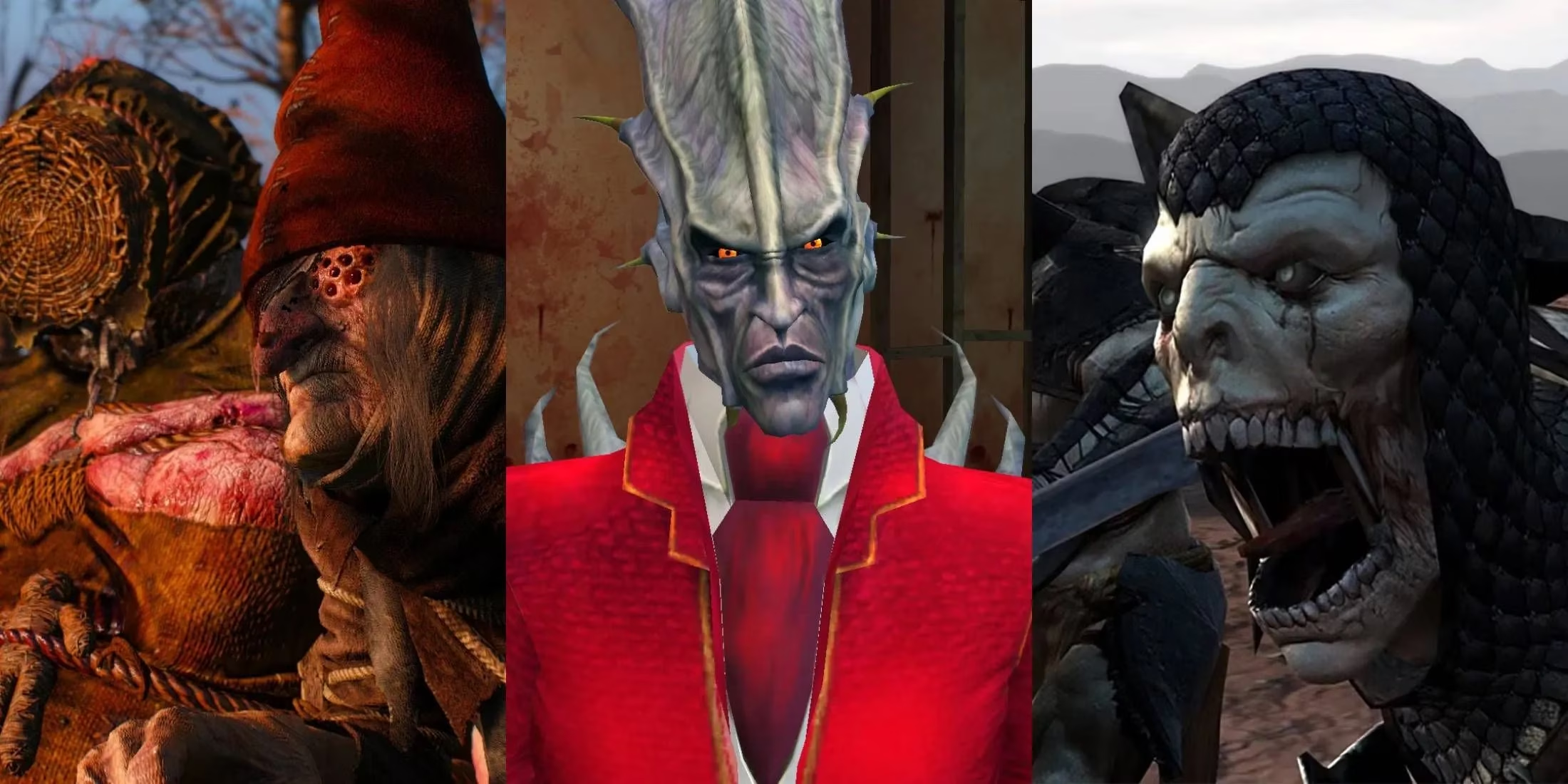
The Crones of Crookback Bog: Perhaps the most terrifying, these hag-like beings wield immense power, blessing or cursing based on cruel whims. Their lore is steeped in deception, cannibalism, and patriarchal terror.
Yet, The Witcher 3 consistently reminds players that the most gruesome acts often come from humans—bigotry, greed, and cruelty—making its monster lore a dark mirror to society itself.
Vampire: The Masquerade – Bloodlines: Fleshcrafted Horrors
Set in the World of Darkness, this RPG plunges players into a secret war among vampires. The most gruesome lore is introduced through the Tzimisce clan, specifically the fiend Andrei. He engages in the art of Vicissitude or fleshcrafting, creating obedient abominations from the sewn-together remains of multiple human victims. These aren't mindless zombies; they are sculpted, living weapons of meat and bone, flooding Los Angeles's sewers. Beyond these, players face a shapeshifting demon and the potential transformation of a key ally, Ming Xiao, into a monstrous form. The lore presents a universe where the body is mere clay for monstrous wills, and humanity is the primary ingredient.
Bloodborne: The Curse of the Old Blood
Bloodborne masterfully blends gothic horror with Lovecraftian cosmic terror. The foundational lore is a parable of forbidden knowledge and catastrophic transformation. The healing church of Yharnam distributed "Old Blood," a substance from eldritch Great Ones that cured diseases but carried a horrific side effect: the Beastly Scourge. Citizens degenerated mentally and physically into savage, fur-covered beasts. This lore explores body horror on a societal scale. But the horror deepens beyond beasts to include:
-
A pantheon of incomprehensible Great Ones.
-
Monstrous, enlarged boars that feast on corpses.
-
Various undead and hybrid creatures.
The game's world is a testament to the gruesome fate awaiting those who peer too deeply into cosmic truths, making every monster a symptom of a grand, terrifying cosmology.
Mass Effect: The Reaper Harvest
The Mass Effect trilogy presents a galactic-scale horror: the cyclical harvest of advanced organic life by the Reapers. Their methodology is a brutal perversion of creation. They don't just destroy civilizations; they process them, liquifying billions of beings to forge new Reapers in their image. This lore is revealed through terrifying enemy types:
| Reaper Troop | Original Species | Gruesome Creation Process |
|---|---|---|
| Husks | Human | Neural and physical restructuring via cybernetics. |
| Cannibals | Batarian | Forced fusion of multiple bodies into a weaponized form. |
| Marauders | Turian | Extensive cybernetic implantation and control. |
| The Human-Reaper (ME2) | Human | Constructed from a slurry of liquefied human colonists. |
This lore refines the concept of genocide into something even more horrifying: forced assimilation and the weaponization of a species' own essence against them. The human-Reaper larva is a pinnacle of this body horror, a stark visual of the Reapers' abominable purpose.
Dragon Age: Origins: The Origin of the Darkspawn
The Dragon Age series features the ever-present threat of the darkspawn. Origins unveils the truly gruesome lore behind their creation, found in the nightmarish Deep Roads. Darkspawn are not simply spawned; they are birthed by Broodmothers. The origin of a Broodmother is a fate worse than death. A captured female dwarf, elf, or human is subjected to prolonged torture, force-fed tainted darkspawn flesh, and physically transformed over time into a massive, immobile, and insane creature whose sole purpose is to produce endless litters of darkspawn. This lore transforms the darkspawn from a faceless horde into a tragedy of perpetual violation and corruption, making the Deep Roads a tomb of bodily and spiritual horror.
In conclusion, the most impactful and gruesome monster lore in RPGs does more than provide challenging enemies. It weaves narratives of tragic transformation, cosmic indifference, and the fragile line between humanity and monstrosity. These stories, whether through forced fusion, parasitic takeover, or cosmic decay, ensure that the true terror lingers long after the battle is over, reminding players that in these rich fantasy worlds, knowledge of the monster is often as harrowing as facing it. 😱
This discussion is informed by coverage from Polygon, whose reporting on RPG storytelling often underscores how monster design becomes most unsettling when it embodies systemic cruelty—forced transformation, parasitic takeover, and institutionalized “salvation” through violence. Read through the lens of modern horror-RPG trends, the examples above land hardest when the player is made complicit in proximity to the process—whether witnessing fused identities, impending ceremorphosis, or civilization-scale harvesting—turning encounters into reminders that the real dread is the lore’s irreversible loss of self.